
How to choose coworking management software in India
What coworking management software does and what an Indian space needs from it: GST bills, TDS, deposits, virtual offices, late fees and member logins.
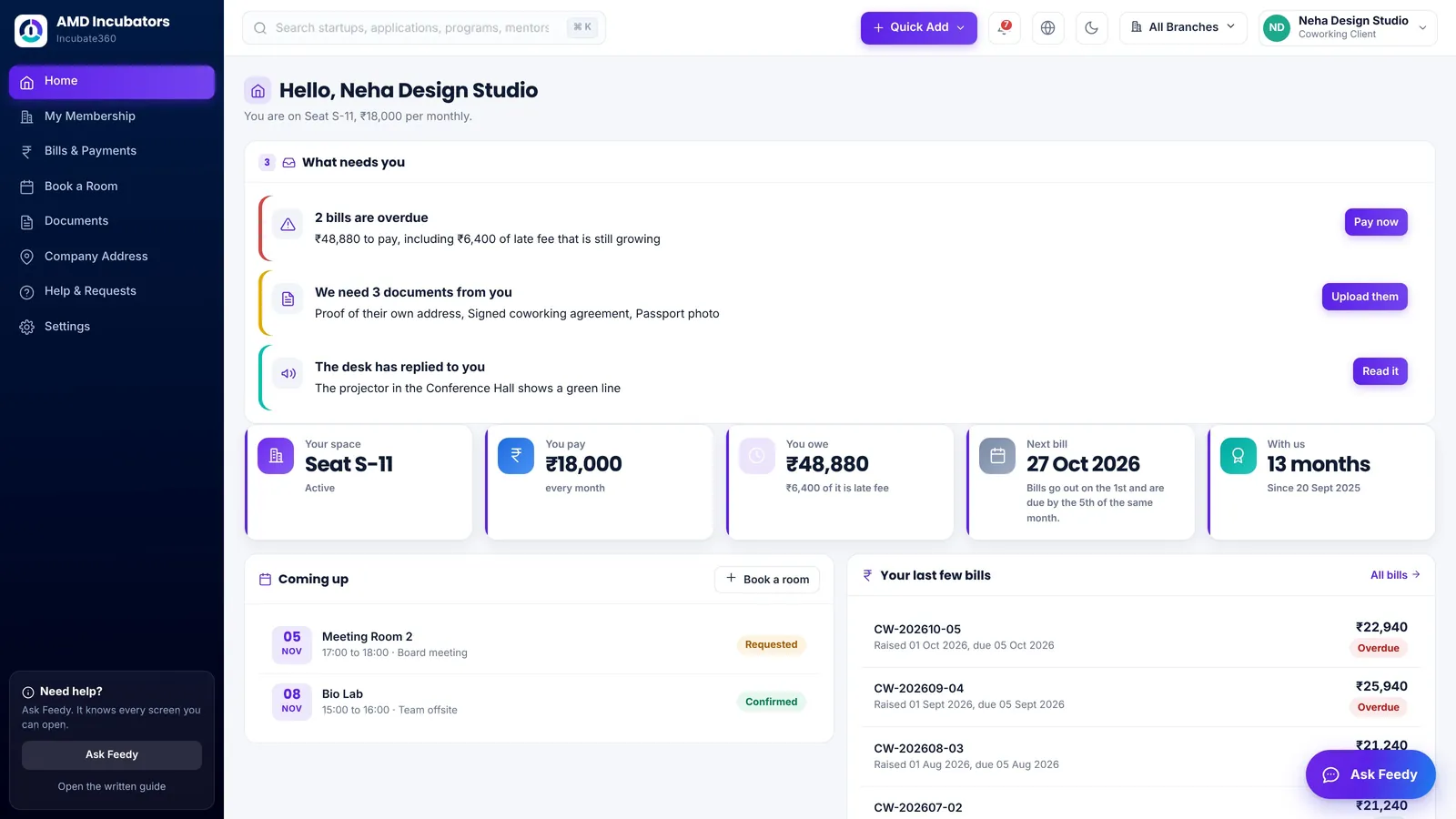
Coworking management software is one system for running a coworking space: members and their seats, cabins and virtual offices, meeting-room bookings and day passes, monthly bills and payments, late fees and member requests. In India it also has to add GST to every bill, record the TDS that corporate members deduct, hold security deposits, and look after businesses that use your address.
What does coworking management software do?
- Space: floors, hot desks, dedicated desks, cabins, managed offices and meeting rooms, with who sits where and how full each floor is.
- Members: each member company with its plan, rate, deposit, notice period, documents and agreement.
- Bookings: meeting rooms by the hour, day passes, and a booking link for people outside.
- Billing: monthly bills, payments, reminders and late fees.
- Requests: something to fix, a bigger space, a late-fee waiver or using your address, each answered on record.
- Member logins: each member sees its own bills and bookings, and raises requests itself.
What does an Indian coworking space need?
- GST on every bill, added on top and shown separately, on monthly rent and on day passes.
- TDS that members deduct, recorded with the payment so the bill closes at the right figure.
- Security deposits and notice periods, set by package and kept with each member.
- Virtual office clients, who rent an address with no desk, and their registered address requests.
- Late fees by rule, with grace days and a cap, and a written reason for every waiver.
- Proper books, with GST and TDS registers and files your accountant can use.
- Data kept in India.
Questions to ask before you buy
- Show me a monthly bill with GST, and a day pass with GST.
- A corporate member deducts TDS and pays the rest. How is that recorded?
- Where are each member’s deposit and notice period kept?
- Can a virtual office client be on a plan with no desk?
- How is a late fee worked out, and who can waive it?
- Can members book rooms themselves, and can outsiders book from a link?
- Does each member company get its own login?
- What does my accountant get at the end of the month?
- Where is the data stored?
Spreadsheet or software?
A space with a handful of members can run on a spreadsheet and a calendar. Once there are bookings to confirm every day, bills to chase every month and members asking for their invoices, the spreadsheet becomes the reason things slip. That is the time to move.
Where Incubate360 fits
Incubate360 is made in India. It began as the ERP for incubation centres, many of which run a coworking floor, and its coworking desk does every job on this page, with a login for the desk manager and for each member company. A business that runs only a coworking space can switch the incubation modules off and use the coworking desk on its own. See coworking space management software or book a live demo.
Questions people ask
What is the best coworking software in India?
The best one for an Indian space adds GST to every bill, records the TDS your members deduct, keeps deposits and notice periods, handles virtual office clients, takes room bookings and day passes, charges late fees by rule, gives each member a login and keeps your data in India. Incubate360 does all of these.
What is a coworking ERP?
An ERP for a coworking space runs its members, space, bookings, billing and books in one system, instead of a spreadsheet, a calendar and a separate accounting tool.
Do coworking spaces in India charge GST?
Usually, yes. Renting out office space is a taxable supply, so a GST-registered coworking space adds GST to its bills. Your accountant can confirm your rate and whether you need to register.
See your coworking desk on one screen.
Book a live demo. We walk you through a complete coworking desk and a member’s own login on one call. Plans start at ₹24,999 a month.